
Most organizations don’t lose knowledge because they fail to document. They lose it because they document the outcome, not the reasoning behind it.
Decisions happen in Slack threads, hallway conversations, Zoom calls, and late-night meetings. By the time the official document is written, the logic, trade-offs, and context are already gone. Six months later, a new team revisits the same problem and unknowingly repeats the same mistakes.
This is institutional amnesia: loss of shared knowledge and experience that walks out the door every time an employee leaves or a team structure shifts. In 2026, this is no longer just an inconvenience; it is one of the most expensive hidden costs in the enterprise
The High Cost of Institutional Amnesia
Traditional documentation systems were built for storage, not memory. Confluence pages, shared drives capture artifacts, but they fail to capture the thought process behind it.
The result is a mounting accumulation of Legacy Debt:
- Ghost Architecture: Workarounds become permanent, unexplained fixtures in your tech stack.
- Strategic Drift: Pivots lose their "why," leading teams to execute on outdated logic.
- Institutional Drag: New hires restart debates that were settled years ago, killing momentum.
IDC research indicates that mid-to-large enterprises lose roughly $4.5 million in annual productivity simply because employees cannot find or recreate the "logic" behind existing systems. (Iterators).
For a deeper look at how these inefficiencies impact your bottom line, explore our guide: The ROI of AI in 2026: Eliminating Enterprise Workflow Bottlenecks with Custom Integration.
Why Traditional Search Fails and AI Agents Succeed
Search engines retrieve documents. Memory requires understanding. An AI Agent doesn’t just index keywords; it reconstructs context. Instead of asking, “Where is the billing doc?” you can ask, “Why did we choose this specific vendor over the incumbent?” This shift from "search" to "context recall" is powered by three distinct capabilities:
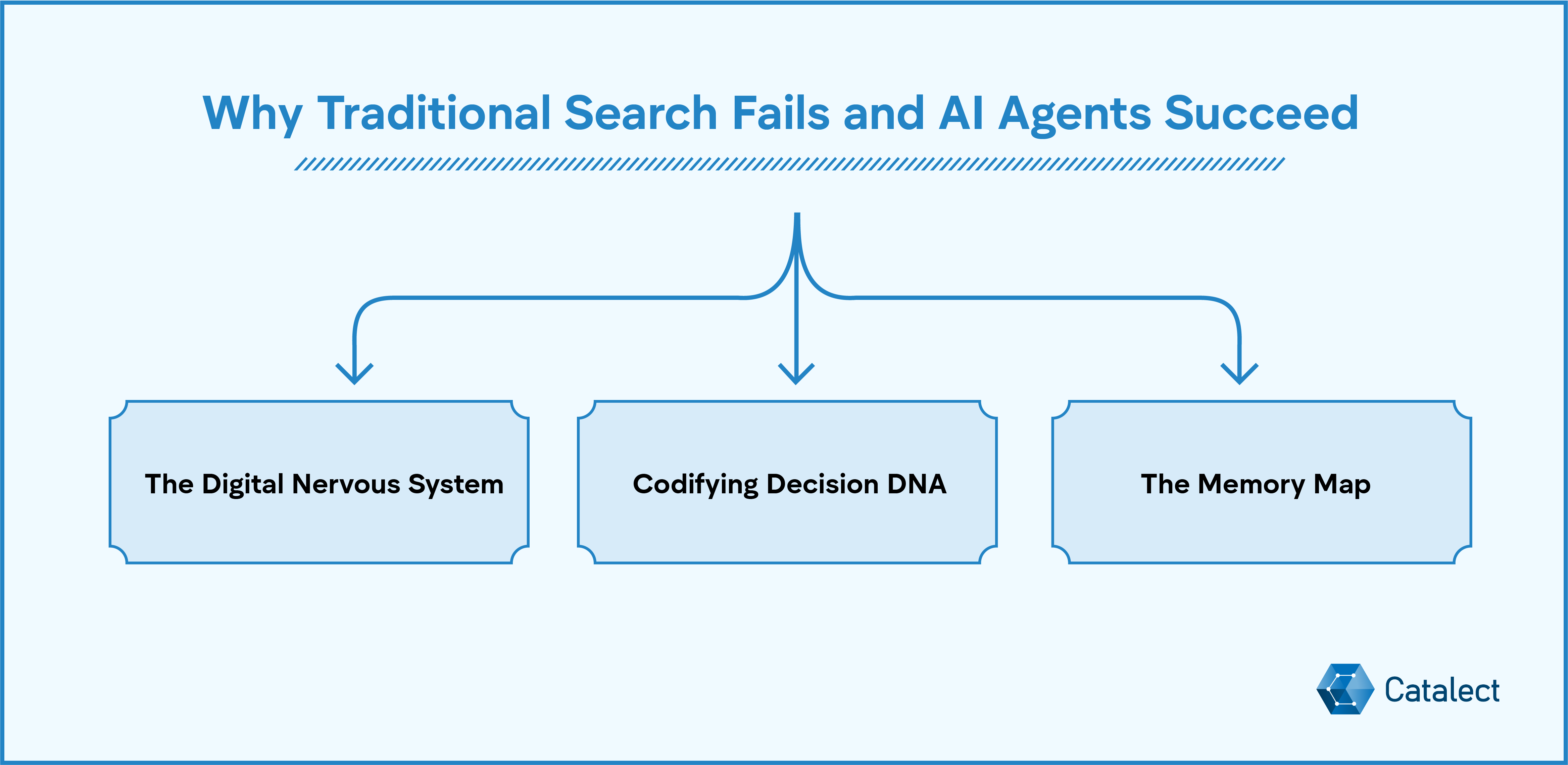
1) The Digital Nervous System (Passive Capture)
Agents observe decision trails across the communication layer, Slack, email, Jira, mapping how an idea evolved from a "what if" to a "SOP" in real-time.
2) Codifying Decision DNA (Reasoning Chains)
Instead of waiting for a quarterly review, the agent prompts stakeholders to log the rationale immediately after a major shift is detected in a thread. It captures the "why" while it's still fresh.
3) The Memory Map (Graph-Based Knowledge)
Data is no longer trapped in folders. It’s modeled as a Knowledge Graph, connecting people, constraints, and outcomes. This allows the AI to understand that Project A failed not because of the code, but because of a Regulatory Constraint that existed in 2024.
By structuring information as relationships and semantic meaning rather than isolated documents, AI can interpret context, not just index files.

From Archive to Active Intelligence in Enterprise Knowledge
The breakthrough isn’t just preserving knowledge; it’s operationalizing it. Corporate memory becomes most valuable when it can advise future decisions.
Consider a Tier-1 bank migrating its billing platform. Instead of the team starting from scratch, the AI Agent interrupts the kickoff:
"In 2023, this specific microservices architecture was rejected because of latency spikes in the ERP integration. We have since upgraded the ERP, but the original latency threshold (50ms) remains a risk."
This transforms memory into Institutional Recall. The ability to remember why past decisions were made and what the trade-offs were. In fact Microsoft recently noted, "AI Readiness" is no longer about how much data you have, but how effectively your agents can reason with the context of your past (Microsoft).
This reinforces the idea that AI Readiness isn’t about how much data you have, it’s about how effectively your systems can reason with the context of your past decisions and knowledge. If your current systems are standing in the way of this evolution, explore our guide: Legacy System Modernization with AI: The 2026 Enterprise Infrastructure Checklist.
At Catalect we’ve seen that the organizations that thrive are those that treat their internal history as a live asset. By deploying agentic systems that proactively surface these memory triggers, our clients are effectively ending the era of starting from scratch every time a project lead rotates out.
The Three‑Step Foundation for a Self‑Documenting Organization
Building corporate memory is a systems design problem, not a software purchase issue.

- Step 1: Establish the Digital Nervous System: Connect AI to the communication layer where decisions actually happen.
- Step 2: Define the Logic Schema: Teach the system to recognize "High-Stakes Decisions", budget shifts, architectural changes, or strategic pivots.
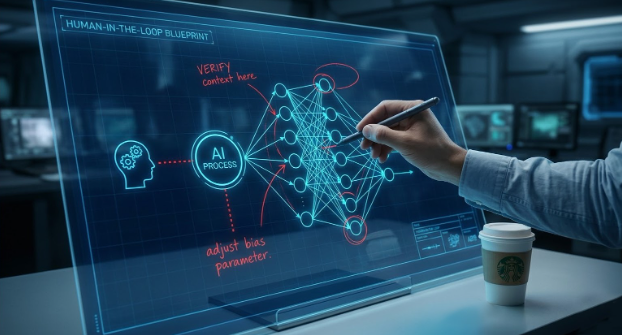
- Step 3: Human-in-the-Loop Validation: Memory must be accurate to be authoritative. Implement a "Human-in-the-Loop" check for high-level strategic summaries.
The End of Forgetful Organizations
In the coming decade, the most valuable enterprise capability won’t be faster analytics or better dashboards. It will be organizational memory. Companies that remember why decisions were made will outlearn and outmaneuver those that only remember what happened. The future enterprise won’t just be data-driven; it will be memory-driven. And AI agents will be the custodians of that legacy.
Building the Architecture of Recall
The transition from a forgetful organization to a memory-driven one doesn't happen by accident. It requires a fundamental shift in how we treat the "logic" of our teams.
At Catalect, we specialize in designing the frameworks that allow AI agents to capture, structure, and surface the reasoning that defines your enterprise. We help organizations ensure that their most valuable insights don't vanish into the digital ether, but instead become the foundation for every future decision.
Let’s explore how we can transform your documentation from a static graveyard into an active decision partner.