.png)
Turn Your Idea Into a Working Proof-of-Concept in Weeks
Validate the feasibility of your AI workflows and intelligent agents with a secure, functional prototype before committing full-scale development.





Ground your vision in technical reality, before you fund it
A demo runs on clean data. Production doesn’t. Our validation sprint tests AI against real data, transaction volumes and operational constraints, surfacing bottlenecks before you fund the build. You leave with a functional prototype, ROI, dependencies, and a deployment path.
A functional AI Proof-of-Concept built around your actual data and workflows, so your team can interact with it, test real use cases, and see how the solution performs outside a controlled demo environment.
Token-billed APIs give you a clean per-task cost number. Self-hosted models don't, there's no per-token bill, so the cost per task comes from amortized GPU-hours over the throughput you actually get. We build the right calculation for your deployment path. For high-concurrency use cases, we also measure p95 latency and concurrent session capacity, since that's usually the real limit. An assessment of whether your data, systems, and infrastructure can actually support each priority use case before development begins.
A practical assessment of how the solution handles your data and where production risks may exist. We map data flows, access controls, isolation, encryption, guardrails, failure points, and other technical considerations so your team understands what must be addressed before deployment. What to build first, second, and third, with the dependencies, effort, and reasoning behind each decision. Your engineering team gets a clear plan for what to build, in what order, and what needs to happen first.
A concrete path from validated prototype to production. We document the infrastructure, integrations, dependencies, engineering work, security requirements, and scaling considerations needed to turn the PoC into a production-ready system.
You findout whether the idea is worth building at scale. The evidence from the sprint gives your technical and business stakeholders what they need to make the next investment decision with confidence.
How we decide if it's worth building
Before the sprint starts, we agree the ground-truth set, who owns labeling it, and the exact threshold that counts as a pass.

Build
The prototype cleared the bar on accuracy, cost, and security. We hand you the roadmap and get moving.

Adjust
The idea is close but not there yet, usually a different model, more data prep, or a narrower first use case. We tell you exactly what to change.

Stop
The economics or the data don't support it. You walk away with a clear answer, for a fraction of what a failed full build would have cost.
ROI you can measure instantly



From kick-off to functional prototype
A focused engineering sprint that turns your use case into a functional, validated prototype with measurable results.
Understand Business Needs
We scope your core use case, map the existing workflow, identify the systems and people involved, and define what success looks like in measurable terms.
Data & Technical Feasibility
We evaluate your data quality, infrastructure, integrations, and security requirements, then connect to a safe, partitioned slice of your real data to confirm the use case is technically viable.
Design the AI Solution
We define the workflow logic, select the right models and tools, and design the architecture around your specific use case, nothing generic, nothing reused from another client's build.
Build the Proof-of-Concept
We build the core pipeline, engineer the prompts, and add guardrails, encryption, and human-override points, so your team can safely test the working prototype against real-world conditions.
Validate & Production Plan
Your team runs real queries against the prototype. We measure performance against the success criteria, break down the expected costs, identify what needs refinement, and hand over a clear production roadmap.
The engineering layer underneath
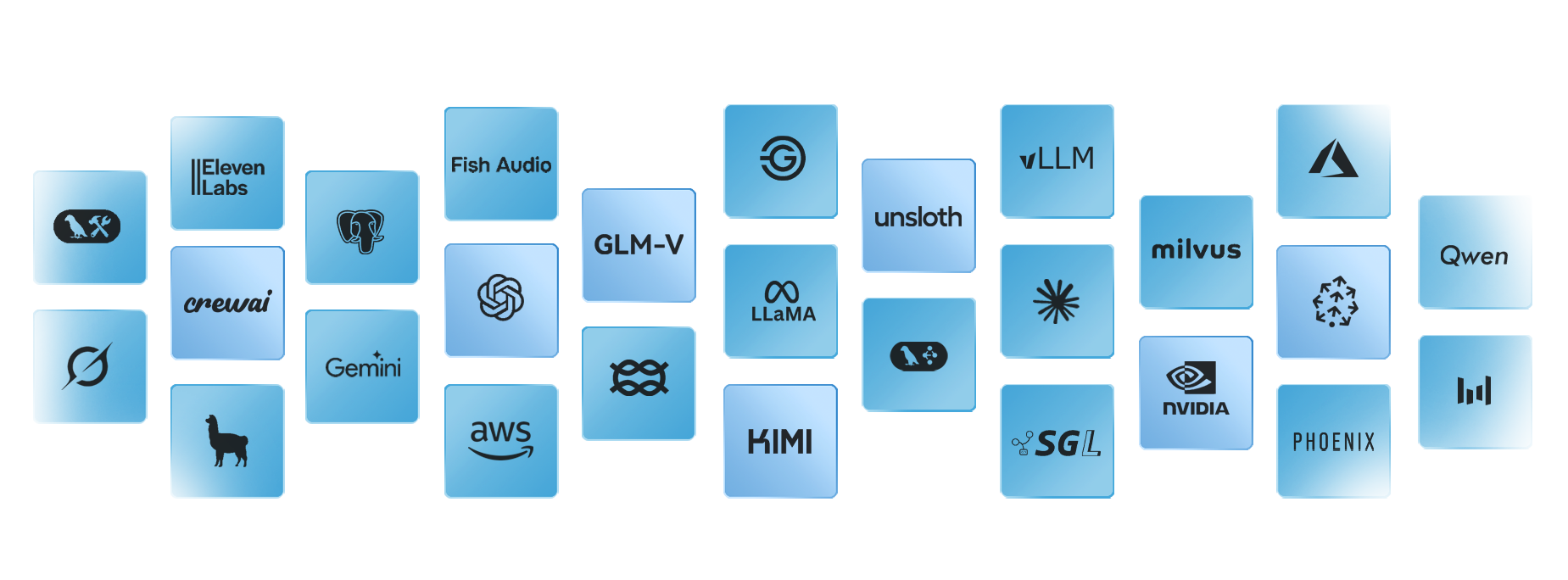
We build on established frontier models and open-source infrastructure, your internal team can pick up and run after we hand it off.
Proof-of-concept use cases across industries
We map our prototyping framework directly to your vertical's regulatory and operational constraints. Here is what we can build and validate for your team.
Frequently asked questions
What is an AI proof of concept?

How do I know if we're ready for an AI PoC?
Is this the same as an AI feasibility study?
How is an AI PoC different from an MVP or a pilot?
How much does an AI proof of concept cost?
How long does an AI PoC take?
What if the PoC fails?
Who owns the IP generated during the sprint?
What happens to the work if we don't move forward with you afterward?
Will our proprietary data be used to train public AI models?
Do you need all of our data upfront?
Can this run inside our environment?
Why do AI projects fail?
What happens after a successful PoC

AI Agent Development
Authenticate the caller, pull real account data, and resolve it without a handoff.
Workflow Automation
Catch the exceptions that manual processes miss, and route only the real ones to a person.
Is your use case ready to build?
Discuss your business challenge with our team, and find out exactly how a PoC can validate it, before you commit a budget.